Shout it from the Roof Tops

Message Title: Shout it from the Roof Tops
Theme: God’s consistency
Season: Christmas
Main Text: John 1:(1-9), 10-18
Scripture Reading: Jeremiah 31:7-14
RCL Scripture: Jeremiah 31:7-14; Psalm 147:12-20; Ephesians 1:3-14; John 1:(1-9), 10-18
Focus: Jesus was present & part of the plan from the beginning.
Function: To practice awe and wonder while considering the implications of our beliefs on our lives.
Other Notes: (Hidden Ministries/Mission of the Month)

SCRIPTURE READING: Jeremiah 31:7-14 7The Lord proclaims: Sing joyfully for the people of Jacob; shout for the leading nation. Raise your voices with praise and call out: “The Lord has saved his people, the remaining few in Israel!” 8I’m going to bring them back from the north; I will gather them from the ends of the earth. Among them will be the blind and the disabled, expectant mothers and those in labor; a great throng will return here. 9With tears of joy they will come; while they pray, I will bring them back. I will lead them by quiet streams and on smooth paths so they don’t stumble. I will be Israel’s father, Ephraim will be my oldest child. 10Listen to the Lord’s word, you nations,  and announce it to the distant islands: The one who scattered Israel will gather them and keep them safe, as a shepherd his flock. 11The Lord will rescue the people of Jacob and deliver them from the power of those stronger than they are. 12They will come shouting for joy on the hills of Zion, jubilant over the Lord’s gifts: grain, wine, oil, flocks, and herds. Their lives will be like a lush garden; they will grieve no more. 13Then the young women will dance for joy; the young and old men will join in. I will turn their mourning into laughter and their sadness into joy; I will comfort them. 14I will lavish the priests with abundance and shower my people with my gifts, declares the Lord.

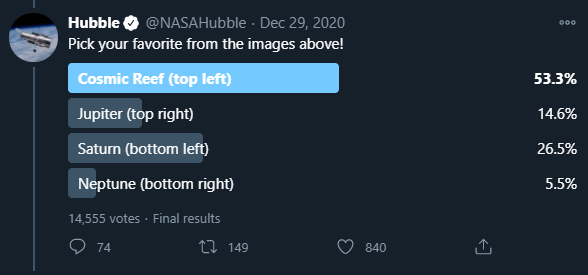
INTRO: Though many of you have already taken down your Christmas decorations, this a still a season of awe and wonder. On Dec 29th, 2020 NASA took a poll through their twitter feed @NASAHubble to pick the Hubble photo of the year. Let’s take a look at the four options.


  1. 2020 Hubble space telescope photos
    1. Cosmic Reef
    2. Jupiter
    3. Saturn
    4. Neptune
  2. Which is your favorite?
  3. Polling Results PHOTO
  4. Did you know that most photos taken by Hubble have been digitally edited in one way or another?
    1. This doesn’t mean NASA is lying to us, but that the technology we use to capture photos doesn’t work like a typical camera.
    2. Through the data they receive they are able to make estimations about the colors in the photos.
      1. “Finished color images are actually combinations of two or more black-and-white exposures to which color has been added during image processing. The colors in Hubble images, which are assigned for various reasons, aren’t always what we’d see if we were able to visit the imaged objects in a spacecraft. We often use color as a tool, whether it is to enhance an object’s detail or to visualize what ordinarily could never be seen by the human eye.”
    3. Sources:
      1. https://www.space.com/8059-truth-photos-hubble-space-telescope-sees.html
      2. http://hubble.stsci.edu/gallery/behind_the_pictures/meaning_of_color/
      3. https://www.businessinsider.com/how-hubble-images-are-manipulted-2015-3
      4. https://www.youtube.com/watch?app=desktop&v=WSG0MnmUsEY
      5. https://www.nationalgeographic.com/science/phenomena/2015/01/05/hubble-revisits-an-icon-the-pillars-of-creation/#close
      6. https://www.nationalgeographic.com/science/2019/05/dear-hubble-space-telescope-transformed-astronomy-and-us-all/

TRANSITION: Humanity has been curious since the very beginning about our world and the heavens above.In our text for today, John starts his Gospel focusing on the vastness of creation. Let’s zoom out with John and see the big picture of the story of Jesus.

SCRIPTURE: John 1: 1-18 In the beginning was the Word and the Word was with God and the Word was God. 2The Word was with God in the beginning. 3Everything came into being through the Word, and without the Word nothing came into being. What came into being 4through the Word was life, and the life was the light for all people. 5The light shines in the darkness, and the darkness doesn’t extinguish the light. 6A man named John was sent from God. 7He came as a witness to testify concerning the light, so that through him everyone would believe in the light. 8He himself wasn’t the light, but his mission was to testify concerning the light. 9The true light that shines on all people was coming into the world. 10The light was in the world, and the world came into being through the light, but the world didn’t recognize the light. 11The light came to his own people, and his own people didn’t welcome him. 12But those who did welcome him, those who believed in his name, he authorized to become God’s children, 13born not from blood nor from human desire or passion, but born from God. 14The Word became flesh and made his home among us. We have seen his glory, glory like that of a father’s only son, full  of grace and truth. 15John testified about him, crying out, “This is the one of whom I said, ‘He who comes after me is greater than me because he existed before me.’” 16From his fullness we have all received grace upon grace; 17as the Law was given through Moses, so grace and truth came into being through Jesus Christ. 18No one has ever seen God. God the only Son, who is at the Father’s side, has made God known.

Explanation:

  1. Intro to John’s Gospel: John’s Gospel wants everyone to know that Jesus didn’t enter the scene at Christmas. Jesus has always been on the scene. Jesus wasn’t some dude that God liked and claimed as his son. Jesus was God in the flesh. But there are other gods who have similar stories, so John’s gospel focuses on Jesus’ divinity and its uniqueness to other stories of gods-made-flesh.
  2. “in the Beginning” should bring us back to Genesis 1:1. John is saying that Jesus was present at creation as the Word.
  3. Word, Life, Light- Jesus is more than just a man that we meet at Christmas.Jesus is God, who was present with us at the beginning.

INTERPRETATION & APPLICATION: To practice awe and wonder while considering the implications of our beliefs on our lives.

  1. Awe & wonder are significant elements in our worship of God. Our God is three in one: Father, Son, and Holy Spirit. This idea is way bigger than my brain can understand. The complexity should lead to worship.
    1. And perhaps worship starts out as questions which can lead to wonder.
  2. AUDIENCE ENGAGEMENT:  I want to play a philosophy game with you for a moment. I will ask a question that I want us to ponder together. I am not looking for a “right answer” but for thoughtfulness.
    1. Why did God make other “stuff” besides earth & the sun?
      1. Did God make creation FOR us?
      2. If not, then why did God make creation?
    2. When I think about these questions, and the answers I develop, it changes the way I view the world and how I interact with it.
  3. Honesty time: When I read scripture, I don’t always think of a tangible way to apply the words I read. Frequently, the words continue to inform me about who God is and the collective information adjusts my behavior.
    1. Atomic Habits by James Clear
      1. One nugget from this book: The way we think or speak about ourselves places a large impact on our habits or behavior.
    2. This passage in John makes me think, “… Ok, and now what?” I don’t hear a practical step screaming out from this passage. However, I am filled with awe about God.
  4. AUDIENCE ENAGEMENT: How would the knowledge that Jesus was present at creation and not just at Christmas change things for you?
    1. How do your beliefs create a chain reaction to other parts of your life?

CONCLUSION: Knowledge of the wonders of God *should* stir something inside of us. Much like seeing the majesty of space leads to awe and wonder. It’s exciting to talk about the discoveries NASA and Space X are making. Do we talk about our discoveries with God?

The goal is not to provide a guilt trip but a time of reflection. We have survived 2020 and know that there are no guarantees in 2021. How do we make 2021 a year that God’s kingdom comes to this world? The possibilities are in your hands.

COMMUNION: As we dwell in the awe of God, we will also take time to celebrate communion together.

Let’s dwell in the mystery of Bread & Juice, as it represents Jesus’ body and blood and the salvation we receive through him.
Risky Business

12/6/2020 at Liberty Baptist Church in Tipton, In

Message Title: Risky Business
Theme: Waiting on God
Season: Advent
Main Text: Isaiah 40:1-11;
Scripture Reading: Mark 1:1-8
RCL Scripture: Isaiah 40:1-11; Psalm 85:1-2, 8-13; 2 Peter 3:8-15a; Mark 1:1-8
Focus: God speaks of a future peace for Judah.Function: To commit to a life of peace-bringing and search out ways to bring peace.
Other Notes: Traditional themes each week: Hope, Peace, Joy, Love

SCRIPTURE READING: Mark 1:1-8 The beginning of the good news about Jesus Christ, God’s Son, 2happened just as it was written about in the prophecy of Isaiah: Look, I am sending my messenger before you. He will prepare your way, 3a voice shouting in the wilderness: “Prepare the way for the Lord; make his paths straight.” 4John the Baptist was in the wilderness calling for people to be baptized to show that they were changing their hearts and lives and wanted God to forgive their sins. 5Everyone in Judea and all the people of Jerusalem went out to the Jordan River and were being baptized by John as they confessed their sins. 6John wore clothes made of camel’s hair, with a leather belt around his waist. He ate locusts and wild honey. 7He announced, “One stronger than I am is coming after me. I’m not even worthy to bend over and loosen the strap of his sandals. 8I baptize you with water, but he will baptize you with the Holy Spirit.”

WAITING:

  1. Engage audience
    1. Check in: How’s your Luke read through? (should be at ch 6 by now)
    2. Travel:
      1. Longest road a person can travel (also most dangerous road)
      2. What was your longest road trip?
        1. PHOTO: Drive to Kokomo, Dec 2017- was supposed to be 12 hours became 18 hours because of ice & a moving van that topped out at 55mph. Yup, 18 hours in 24 hours.
      3. How many states have you been to?
        1. MAPS: Family has driven through all but 5 of the states together
  2. My story: so frequently the first image that comes to our mind when we think of family trips is the repetitive questions from kids: “Are We There Yet? When can we eat? How much longer? I’m bored!”
    1. PHOTO: Well, one of my strongest road trip memories, apart from traveling to Indiana four Decembers ago, was when my parents left me in the Grand Tetons. I joke that they tried to get rid of me. My parents are still mortified.
      1. I can’t remember for certain but I *think* I was 9.
    2. My family, my aunt & uncle, cousins, and my grandparents were on a camping trip together. Before we arrived at the campground, our caravan stopped at a bathroom. I left my grandparents’ car, told them I was going to ride with my parents, and went to the bathroom. When I came out of the bathroom, all three cars were gone. Little did I know, they were just about a mile up the road checking into the campground and hadn’t realized that I was not in any of the vehicles.

TRANSITION: Waiting for my parents to come back to get me felt like forever. In our text for today, Judah hears words of comfort as they are waiting to return from exile.

SCRIPTURE & EXPLAINATION: Isaiah 40:1-11 –God speaks of a future peace for Judah.

Vs 1-2 Comfort, comfort my people! says your God. 2Speak compassionately to Jerusalem, and proclaim to her that her compulsory service has ended, that her penalty has been paid, that she has received from the Lord’s hand double for all her sins!

  1. Exile is fresh in ch 40
    1. Hoping back in time from the text of last week
    2. Ch 39 was the end of a section of judgement and harshness, now we hear a word of hope.
      1. Time of hope (you’re in exile but not forever)

Vs 3-8 3A voice is crying out: “Clear the Lord’s way in the desert! Make a level highway in the wilderness for our God! 4Every valley will be raised up, and every mountain and hill will be flattened. Uneven ground will become level, and rough terrain a valley plain. 5The Lord’s glory will appear, and all humanity will see it together; the Lord’s mouth has commanded it.” 6A voice was saying: “Call out!” And another said, “What should I call out?” All flesh is grass; all its loyalty is like the flowers of the field. 7The grass dries up and the flower withers when the Lord’s breath blows on it. Surely the people are grass. 8The grass dries up; the flower withers, but our God’s word will exist forever.

  1. God doesn’t want to punish Judah. God wants to restore God’s people. Clear the way! It’s gonna happen.
    1. Think of the song I posted on our FB group: “Ain’t not mountain high enough / ain’t no valley low enough / ain’t no river wide enough/ to keep me from getting to you”
    2. Jesus said in the Gospels- “even the rocks will cry out” if God’s people don’t praise him. (Luke 19)
  2. Judah needs consequences for their actions. Judah needs to follow the covenant commitment.
    1. It has been GENERATIONS since the 10 commandments given at Sinai
    2. Each generation has struggled to maintain the covenant.

vs 9-11 9Go up on a high mountain, messenger Zion! Raise your voice and shout, messenger Jerusalem! Raise it; don’t be afraid; say  to the cities of Judah, “Here is your God!” 10Here is the Lord God, coming with strength, with a triumphant arm, bringing his reward with him and his payment before him. 11Like a shepherd, God will tend the flock; he will gather lambs in his arms and lift them onto his lap. He will gently guide the nursing ewes.

  1. Now if you were to continue reading in this chapter, the imagery of comforting Judah continues to the famous quote of “rising up on wings like eagles.” God will care for God’s people.
  2. Judah has received the consequences of their actions, and now God calls them to obedience and a future peace.

RELATABILITY/ INTERPRETATION:

  1. Judah appears much like a lost puppy during exile. A loss of identity, as they are separated from their people, their land, and their God. They are lost without their identity.
    1. Does this sound like 2020 or what? Digital church, no normal family holidays, quarantined from society.
  2. God wants our flourishing and gives us opportunities for peace. However, we frequently reject those opportunities.
  3. We are the ones needing to shift our focus from us to God.
    1. God’s life leads to flourishing.
  4. Back to the Intro: As soon as my parents realized I was gone they sent a car back to pick me up. While I was waiting a family sat with me and waited for someone to return.
    1. Road trips are frequently not

ACTION/APPLICATION: To commit to a life of peace-bringing and search out ways to bring peace.

  1. Real Peace vs. “being nice”- Not the same as being nice or avoiding problems or conflict.
    1. Real peace gets messy and risky: Loving people gets messy. Loving people is an act of vulnerability/exposure. You put yourself at risk. But God calls us to those risky places.
      1. As we talked about last week, loving people is hard.
      2. Bringing peace is unpopular. Media and entertainment thrive on disputes.
    2. Real peace leads to social faux pas and being counter cultural.
      1. Not a license to tell gay people they are going to hell
      2. Not a license for denominational wars or telling someone their denomination’s theology is bad
      3. Not a license to play the martyr when someone disagrees with you
  2. Practical reality of living 10 commandments is flourishing of relationships. Can we think of examples without getting legalistic?
    1. Whiteboard:
      1. Loving God
      2. Loving Others
  3. God says God will level the mountains & fill in the valleys to make this peace come. We are his peace-bringers. What if God hands us a shovel and a pickaxe rather than snapping a finger and making it happen? We are the ones called to fill in the valleys and level the mountains to make God’s highway wide.

CONCLUSION

COMMUNION: Fran Pratt- Litany for Eucharist

God, You’re Late

11/29/2020 at Liberty Baptist Church in Tipton, In

Message Title: God, You’re Late
Theme: Waiting on God
Season: Advent
Main Text: Isaiah 64:1-9;
Scripture Reading: Mark 13:24-37
RCL Scripture: Isaiah 64:1-9; Psalm 80:1-7, 17-19; 1 Corinthians 1:3-9; Mark 13:24-37
Focus: Isaiah asks God to provide Judah’s hope of restoration. (the People are blaming God)
Function: To pick up our Gospel responsibility and leave God’s responsibilities to God.
– To wait, trust, and hope in God’s promises
Other Notes: Traditional themes each week: Hope, Peace, Joy, Lov

Scripture reading: Mark 13: 24-27 24“In those days, after the suffering of that time, the sun will become dark, and the moon won’t give its light. 25The stars will fall from the sky, and the planets and other heavenly bodies will be shaken. 26Then they will see the Human Onecoming in the clouds with great power and splendor. 27Then he will send the angels and gather together his chosen people from the four corners of the earth, from the end of the earth to the end of heaven. 28“Learn this parable from the fig tree. After its branch becomes tender and it sprouts new leaves, you know that summer is near. 29In the same way, when you see these things happening, you know that he’s near, at the door. 30I assure you that this generation won’t pass away until all these things happen. 31Heaven and earth will pass away, but my words will certainly not pass away. 32“But nobody knows when that day or hour will come, not the angels in heaven and not the Son. Only the Father knows. 33Watch out! Stay alert! You don’t know when the time is coming. 34It is as if someone took a trip, left the household behind, and put the servants in charge, giving each one a job to do, and told the doorkeeper to stay alert. 35Therefore, stay alert! You don’t know when the head of the household will come, whether in the evening or at midnight, or when the rooster crows in the early morning or at daybreak. 36Don’t let him show up when you weren’t expecting and find you sleeping. 37What I say to you, I say to all: Stay alert!”

Intro to New Series: Waiting on God (an Advent Series) – This series will explore waiting for the Messiah from an Old Testament perspective. Advent is frequently misconstrued as a season of darkness. Rather, let’s picture it like dawn, the light is coming. (Photo) Dawn also coordinates with the colors of advent. Color: Blue/Purple & Pink

  1. Advent is about the building anticipation for the Birth of Jesus & getting ready for the fulfillment of God’s promises. (Standing on the promises of God *song)
    1. Decorate: get yourself a nativity- I’ve found a few printable ones with cut out figures. Set out the stable and progressively (each week) add more things. Don’t add Mary or Joseph until Christmas eve and don’t add Jesus until Christmas day.
    2. Tell the story: read the Gospel of Luke each day until Christmas. You’ll get through all of Jesus’ ministry by day 24.

TRANSITION: The broad theme for Advent is waiting with anticipation. Now, I know that as 2020 survivors, we’re sick of waiting. Perhaps, this season can be a healing salve to that wound. So, let’s focus on waiting from a joyful vantage point.

WAITING:  I want to hear your thoughts on anticipating a baby.  

  1. Engage the Audience:
    1. What do we traditionally do to prepare for a baby?
      1. Hospital bag- What did you pack? What did you wish you pack, but you didn’t?
    2. Do you feel you were fully prepared for the extent of parenthood?
  2. Expectations VS. Reality
    1. It’s common that before you became a parent, you build ideas of what you will or won’t do to be the best parent possible. How many of you broke your own rules/expectations?
    2. As a family prepares for a baby, preparations are expected to happen while waiting for the “time to come.” However, often we are surprised by the reality of life with babies. Yes, I am saying this as a woman without kids. Expectations and Reality don’t always line up.
      1. Preparation: Finances, house safety updates, supplies, medical/birth plan, etc
      2. Reality: not just about rosy cheeks, bodily fluids, pain, healing, crying, sleepless nights, nursing struggles, etc.

TRANSITION:  In our text for today, we are returning to Isaiah to hear a word on expectant waiting.

  1. Reminder of the story of Isaiah: If you remember, we were just in Isaiah in October. We looked at Isaiah 5, 25, & 45. We will get a few more glimpses into Isaiah during this series, along with another Old Testament text. (Ch 64, 40, 61).
    1. Here’s a refresher on what we know about the book of Isaiah:
      1. 2 kingdoms: Isaiah is speaking to Judah. Israel is going to get wiped out before the end of this book. Babylon will take Judah into exile.
      2. 66 chapters in this book, 150ish years covered.
      3. Scholars consider Isaiah split into 3 sections (and three authors): Pre-exile (announced coming judgement), Exile, Post Exile/Hope of return.
    2. CHART- where we are in the timeline

SCRIPTURE: Isaiah 64: 1-9 If only you would tear open the heavens and come down! Mountains would quake before you 2like fire igniting brushwood or making water boil.  If you would make your name known to your enemies, the nations would tremble in your presence. 3When you accomplished wonders beyond all our expectations; when you came down, mountains quaked before you. 4From ancient times, no one has heard, no ear has perceived, no eye has seen any god but you who acts on behalf of those who wait for him! 5You look after those who gladly do right; they will praise you for your ways. But you were angry when we sinned; you hid yourself when we did wrong. 6We have all become like the unclean; all our righteous deeds are like a menstrual rag. All of us wither like a leaf; our sins, like the wind, carry us away. 7No one calls on your name; no one bothers to hold on to you, for you have hidden yourself from us, and have handed us overto our sin. 8But now, Lord, you are our father. We are the clay, and you are our potter. All of us are the work of your hand. 9Don’t rage so fiercely, Lord; don’t hold our sins against us forever, but gaze now on your people, all of us:

EXPLAINATION: Isaiah asks God to provide Judah’s hope of restoration. (the People are blaming God)

  1. The Text: Isaiah offers a prayer to God that sounds like an accusation, depending on the translation you read. The Jewish translation accuses God for humans’ sin by making a system impossible to follow.
    1. “if only you would….”
    2. “If you would…”
    3. “When you accomplished…”
    4. “for you have hidden yourself… handed us over”
    5. “Don’t hold our sins against us forever…”
  2. Break down: Judah is returning from an exile in a foreign land. They were away from God’s holy land as a consequence for their actions.
    1. Their sins: Basically, ignoring the 10 commandments entirely.
      1. disloyalty to others: Judah was ignoring the poor, widow, foreigner, oppressed, etc.
      2. disloyalty to God: Befriending other nations and worshipping their gods
      3. Their actions made their borders become vulnerable & Babylon oppressed them
    2. Isaiah’s words in response to God’s actions
      1. Acknowledged their sins
      2. Called out for deliverance
      3. Waiting on God to show up

INTERPRETATION: Isaiah asks God to provide Judah’s hope of restoration. (the People are blaming God)

  1. Consequences: Not following God’s commands has consequences. No, not God giving us a spanking. The consequences break up relationships between us, God, and others. We sabotage ourselves.
  2. Ownership for not living God’s Word
    1. (inspired by EBC) Are we in the cycle of sin because of our own actions or because God won’t save us?
      1. Jewish translation of Isaiah’s words: It’s all God’s fault. I’ll continue to do my thing until God rescues me. God’s people are skilled at wanting praise or rewards, not so great at ownership of actions or receiving of consequences. “Lord, have mercy! They made me do it!” or “you made me this way!”
  3. Orthodoxy vs orthopraxis: Time to stop blaming God and take ownership for our actions.
    1. Time to act the way we speak. God’s people were good at knowing the words to say but bad at living them.

APPLICATION: Act on This– To pick up our Gospel-responsibility and leave God’s responsibilities to God.

  1. We love to play God. But it’s God’s job to be God. It’s our job to be God’s people. We have joint responsibility in the Gospel story. God’s job is Gods. Our job is ours. We need to stop waiting on God to solve immediate problems.
  2. As we expectantly wait for the celebration of Christmas, we remember we are expecting Christ to return again.
  3. Our job is not to sit idly by. Our job is to tell people of the love of God.
  4. Call to action:
    1. Take ownership: Stop language that blames God for the consequences of your actions
    2. Take Action: Love God, Love People
      1. Matt 28:18-20 18Jesus came near and spoke to them, “I’ve received all authority in heaven and on earth. 19Therefore, go and make disciples of all nations, baptizing them in the name of the Father and of the Son and of the Holy Spirit, 20teaching them to obey everything that I’ve commanded you. Look, I myself will be with you every day until the end of this present age.”
        1. Acts 1:9-11 9After Jesus said these things, as they were watching, he was lifted up and a cloud took him out of their sight. 10While he was going away and as they were staring toward heaven, suddenly two men in white robes stood next to them. 11They said, “Galileans, why are you standing here, looking toward heaven? This Jesus, who was taken up from you into heaven, will come in the same way that you saw him go into heaven.”
      2. 1Cor 11: 26 26Every time you eat this bread and drink this cup, you broadcast the death of the Lord until he comes.
      3. 2 Peter 3: 8-10 8Don’t let it escape your notice, dear friends, that with the Lord a single day is like a thousand years and a thousand years are like a single day. 9The Lord isn’t slow to keep his promise, as some think of slowness, but he is patient toward you, not wanting anyone to perish but all to change their hearts and lives. 10But the day of the Lord will come like a thief. On that day the heavens will pass away with a dreadful noise, the elements will be consumed by fire, and the earth and all the works done on it will be exposed.
    3. How will your Christmas season and the end of 2020 be impacted by your commitment to God?
      1. Ways to help people in poverty:
        1. Kokomo Rescue Mission is serving & delivering meals for Christmas
        2. Jubilee with Liberty
        3. United Way buddy bags
        4. Tipton School buddy bags
        5. Jackson St Commons
        6. CAM
        7. Howard Haven
      2. Ways to help people know about Jesus
        1. Invite people to enjoy this stream.
        2. Video Chat with friends and talk about your lives—don’t just get interested in them to rack up “Saved Points” but invest in their lives.
        3. Enter a mentoring or accountability relationship with another believer. Share your lives together. Listen for God together.

CONCLUSION: Loving people gets messy. Doing our Gospel-job is not always easy, much like the expectations of having a baby don’t exactly match reality.  

BENNEDICTION

Farm Animals & Kings

11/22/2020 at Liberty Baptist Church in Tipton, In

Message Title: Farm Animals & Kings
Theme: Christ the King Sunday
Season: ORDINARY
Main Text: Matthew 25:31-46
Scripture Reading: Psalm 100
RCL Scripture: Ezekiel 34:11-16, 20-24; Psalm 100; Psalm 95:1-7a; Ephesians 1:15-23; Matthew 25:31-46
Focus: Jesus’ parable calls for action, not just pretty words.
Function: To get involved in the messiness of the Gospel by loving people that are hard to love. 
Other Notes: thanksgiving//CHRIST THE KING Sunday

SCRIPTURE READING: Psalm 100 Shout triumphantly to the Lord, all the earth! 2Serve the Lord with celebration! Come before him with shouts of joy! 3Know that the Lord is God—he made us; we belong to him. We are his people, the sheep of his own pasture. 4Enter his gates with thanks; enter his courtyards with praise! Thank him! Bless his name! 5Because the Lord is good, his loyal love lasts forever; his faithfulness lasts generation after generation.

Audience Engagement: Holiday traditions

  1. Questions:
    1. What holiday season comes directly after Halloween?
    2. Do you decorate for Christmas before Thanksgiving comes?
    3. What about Christmas music or movies?
    4. What are your favorite Christmas Hymns?
  2. Me:
    1. It wasn’t until I was in seminary that I even knew that there was a difference between Christmas hymns and Advent hymns.
    2. Honestly, until about 4 years ago, I had a poor attitude towards Christmas. Not Christmas, celebrating Jesus’ birth but Retail Christmas. I had worked retail. Retail can definitely suck the joy out of the holiday season.
    3. I haven’t decorated yet, but do intend to this week! Yes, Christmas décor before thanksgiving!

Intro: Today is a unique holiday that you won’t see marketed by Hallmark or Amazon. Today is Christ the King Sunday also called Reign of Christ Sunday.

Today is the last Sunday in the church calendar. This holy day was instituted by Pope Pius the XI(11th) in 1925. Though it wasn’t celebrated on the last Sunday in the year until 1970.

War can leave us full of fear and searching for stability or comfort. The Pope believed that after WWI ended, the world needed to be reminded of the One True King and the hope our King brings.

So, Today we celebrate Christ as our King who reigns forever!

TRANSITION: In our text for today we are going to focus on Jesus’ words. He shares a parable of a king with unique expectations for his subjects that includes scary consequences for those that don’t comply. Should we be filled with fear? Let’s see what the Reign of Christ brings.

SCRIPTURE: Matthew 25:31-46

31“Now when the Human Onecomes in his majesty and all his angels are with him, he will sit on his majestic throne. 32All the nations will be gathered in front of him. He will separate them from each other, just as a shepherd separates the sheep from the goats. 33He will put the sheep on his right side. But the goats he will put on his left. 34“Then the king will say to those on his right, ‘Come, you who will receive good things from my Father. Inherit the kingdom that was prepared for you before the world began. 35I was hungry and you gave me food to eat. I was thirsty and you gave me a drink. I was a stranger and you welcomed me. 36I was naked and you gave me clothes to wear. I was sick and you took care of me. I was in prison and you visited me.’ 37“Then those who are righteous will reply to him, ‘Lord, when did we see you hungry and feed you, or thirsty and give you a drink? 38When did we see you as a stranger and welcome you, or naked and give you clothes to wear? 39When did we see you sick or in prison and visit you?’ 40“Then the king will reply to them, ‘I assure you that when you have done it for one of the least of these brothers and sisters of mine, you have done it for me.’ 41“Then he will say to those on his left, ‘Get away from me, you who will receive terrible things. Go into the unending fire that has been prepared for the devil and his angels. 42I was hungry and you didn’t give me food to eat. I was thirsty and you didn’t give me anything to drink. 43I was a stranger and you didn’t welcome me. I was naked and you didn’t give me clothes to wear. I was sick and in prison, and you didn’t visit me.’ 44“Then they will reply, ‘Lord, when did we see you hungry or thirsty or a stranger or naked or sick or in prison and didn’t do anything to help you?’ 45Then he will answer, ‘I assure you that when you haven’t done it for one of the least of these, you haven’t done it for me.’ 46And they will go away into eternal punishment. But the righteous ones will go into eternal life.”

EXPLAINATION:

  1. Titles used:
    1. Human One- a title used in Daniel
      1. Read Daniel 7:9-14
      2. Some of your translations may say Son of Man.
    2. King
      1. Merging of the Jewish messiah with the Davidic king.
  2. Action of the King
    1. Separates sheep from goats
      1. Sheep/ the ones on the right/ the righteous
        1. fed, clothed, cared for, & visited those in need
      2. Goats/the ones on the left/ receivers of terrible things
        1. Did not feed, cloth, care for, or visit those in need

INTERPRETATION: Jesus’ parable calls for action, not just pretty words.

  1. Background
    1. Gospel Writer: Matthew (Jewish writer to a Jewish audience)
    2. Scripture’s Audience: Disciples (Matt 24:3)
  2. Context:
    1. Up until entering Jerusalem, Jesus used calculated language. With a few exceptions in other gospels, Jesus doesn’t directly call himself the messiah. As you continue to read the Gospel of Matthew, the closer Jesus gets to Jerusalem, the more bold his words become.
    2. This passage is during Holy Week. Jesus had already entered the city triumphantly.  And now Jesus turns his language up to 11 on the controversial scale. At the time of this passage, Jesus is in Jerusalem and days away from being crucified. So he starts to make the statements that he knows will lead to his arrest and crucifixion.
    3. Jesus had been preaching to crowds in the Temple. Then Jesus walked to the Mount of Olives and the disciples pulled him aside to ask more questions.
      1. Jesus will be crucified as a treasonous blasphemer by the church and state. His statements became more overtly political. More overtly about the system being broken and pointing to the One True Kingdom.
  3. It would be easy to get hyper focused on the questions about sheep & goats (Picture) Is Jesus saying literally that sheep are better than goats? Unfortunately, we’re not talking about the literal animals today.  
    1. If you listen, we qualify as both sheep and goats.
      1. “done it for one of the least of these, you have done it for me”
      2. “haven’t done it for one of the least of these, you haven’t done it for me”
      3. Ignoring 1 opportunity means you’re a goat.
  4. But is this passage supposed to make us scared? No. We’re called to action.

APPLICATION: To get involved in the messiness of the Gospel by loving people that are hard to love.

  1. What is interesting about this passage is Jesus seems to contradict himself (from the other gospels). In John 3:17, Jesus tells Nicodemus that the Son came not to condemn the world but to save the world through himself. Now, Jesus is painting himself in to the judgement seat.
    1. Jesus is simultaneously our judge and our savior. He is the one setting the standard, and he is the one fulfilling the standard.
    2. Our actions do not save us. No one can meet these standards laid out by the king, Jesus meets them for us.
    3. But does that mean we don’t even need to try?
  2. Ownership of our faith: I want to take a moment to get our brains active. Everyone should have a note card and a writing utensil. Raise your hand if you don’t, we’ll get some for you.
    1. Notes cards: write down your answers rather than shouting them out.
      1. Who are the people that seem to have “lost their way” to you?
      2. Whose salvation do you worry about?
    2. Congratulations, You’ve just made a starter list of “the least of these.”
      1. How will you love them this holiday season?
      2. *Notice* the King didn’t say
        1. Tell these people they are horrible sinners and unworthy of love.
        2. Tell these people they’re so lucky to receive your kindness.
      3. The king says, those “least of these” – they’re me. Treat them like you would treat me.
  3. Tangible option:
    1. Donate for Jubilee Christmas
    2. Deliver Thanksgiving Meals with the Rescue Mission https://kokomorescuemission.org/event/thanksgiving-day-banquet/
    3. Sponsor a Buddy Bag https://unitedwayhoco.org/sign-up-here-to-be-a-buddy-bag-packing-partner/
    4. Care for a Convict-

CONCLUSION:

  1. Confession: “Things we’ve done and things we’ve left undone.”
    1. People: Most merciful God, we confess that we are by choice sinful and unclean. We have sinned against you in thought, word, and deed, by what we have done and by what we have left undone. We have not loved You with our whole heart; we have not loved our neighbors as ourselves. We justly deserve Your judgement. For the sake of Your Son, Jesus Christ, have mercy on us. Forgive us, renew us, and lead us, so that we may delight in Your will and walk in Your ways to the glory of your Holy Name. Amen.
    2. Pastor (Declaration of Grace): “In the mercy of almighty God, Jesus Christ gave himself to die for us, and for His sake God forgives us all our sins. To those who believe in Jesus Christ, He gives the power to become the children of God and bestows on them the Holy Spirit. May the Lord, who has begun this good work in us, bring it to completion in the day of our Lord Jesus Christ.”
  2. Crazy idea: for 5-10 minutes after church we’ll have discussion time for those wanting to iron out parts of the service that left them puzzled. We will have our benediction and then if people have questions, they can stay and ask questions and I’ll respond as best I can. I won’t guarantee solving the world’s problems but I can offer more clarity.

Forest Roots: A Bonus Episode

Originally preached on 11/15/2020 at Liberty Baptist Church in Tipton, In

Title: Forest Roots: A Bonus Episode
Theme: KNOW YOUR ROOTS
Season: ORDINARY
Main Text: Judges 4:1-7
Scripture Reading: Matthew 25:14-30
RCL Scripture: Judges 4:1-7; Psalm 123; Zephaniah 1:7, 12-18; Psalm 90:1-8, (9-11), 12; 1 Thessalonians 5:1-11; Matthew 25:14-30
Focus:  Israel forgets the dependable character of God.
Function:  To be a Christian requires us to know the history of our faith and our community.
Other Notes:

SCRIPTURE READING: Matthew 25:14-30 14“The kingdom of heaven is like a man who was leaving on a trip. He called his servants and handed his possessions over to them. 15To one he gave five valuable coins, and to another he gave two, and to another he gave one. He gave to each servant according to that servant’s ability. Then he left on his journey. 16“After the man left, the servant who had five valuable coins took them and went to work doing business with them. He gained five more. 17In the same way, the one who had two valuable coins gained two more. 18But the servant who had received the one valuable coin dug a hole in the ground and buried his master’s money. 19“Now after a long time the master of those servants returned and settled accounts with them. 20The one who had received five valuable coins came forward with five additional coins. He said, ‘Master, you gave me five valuable coins. Look, I’ve gained five more.’ 21“His master replied, ‘Excellent! You are a good and faithful servant! You’ve been faithful over a little. I’ll put you in charge of much. Come, celebrate with me.’ 22“The second servant also came forward and said, ‘Master, you gave me two valuable coins. Look, I’ve gained two more.’ 23“His master replied, ‘Well done! You are a good and faithful servant. You’ve been faithful over a little. I’ll put you in charge of much. Come, celebrate with me.’ 24“Now the one who had received one valuable coin came and said, ‘Master, I knew that you are a hard man. You harvest grain where you haven’t sown. You gather crops where you haven’t spread seed. 25So I was afraid. And I hid my valuable coin in the ground. Here, you have what’s yours.’ 26“His master replied, ‘You evil and lazy servant! You knew that I harvest grain where I haven’t sown and that I gather crops where I haven’t spread seed? 27In that case, you should have turned my money over to the bankers so that when I returned, you could give me what belonged to me with interest. 28Therefore, take from him the valuable coin and give it to the one who has ten coins. 29Those who have much will receive more, and they will have more than they need. But as for those who don’t have much, even the little bit they have will be taken away from them. 30Now take the worthless servant and throw him out into the farthest darkness.’ “People there will be weeping and grinding their teeth.
LORD’S PRAYER

Intro: I have good news and bad news—The bad news, you may have noticed already, our guest speaker had to return to Miami, Fl and won’t be with us today.  Good news? You get a bonus ROOTS! Who’s excited?

OUR ROOTS:  Apostles’ Creed We have explored our covenant for three weeks, now I want to introduce another document that is foundational to Christian belief.

  1. The Apostles’ Creed:
    1. Sources say this popped up around 390 AD (Wiki)
      1. Church tradition says that each of the 12 disciples helped form part of this creed, though history/anthropology doesn’t back up that claim. (wiki)
    2. Most basic summary of Christian tenants
      1. Historically used to teach early converts about Christianity
      2. A source of unity for believers
  2. Read the Creed: I believe in God the Father almighty, creator of heaven and earth. I believe in Jesus Christ, his only Son, our Lord. He was conceived by the power of the Holy Spirit and born of the Virgin Mary. Under Pontius Pilate, He was crucified, died, and was buried. He descended to the dead. On the third day he rose again. He ascended into heaven and is seated at the right hand of the Father. He will come again to judge the living and the dead. I believe in the Holy Spirit, the holy Catholic Church, the communion of saints, the forgiveness of sins, the resurrection of the body, and the life everlasting.  Amen.
  3. Baptists & The Creed: What is fascinating is thatBaptists haven’t always been big on the Apostles’ Creed because of the phrase “the holy Catholic Church” and assuming we’re talking about Roman Catholics. The reformation era really made Baptists skeptical of anything Catholic. If only we were able to acknowledge that “catholic” little “c” means unified or whole.
    1. Baptists have actually had a tradition of rejecting “tradition”… Well, as long as “tradition” points to Catholicism…We love the tradition of hymns or pews or our specific order of service or celebrations.
    2. But our tradition of rejecting tradition has become the greatest weakness for Baptists. Our habit to disassociate with the bigger picture of the church leads us to forget where we came from or where we’re going.
  4. TRANSITION: In our text for today we will see that the Israelites have lost sight of their roots and have become vulnerable to other kingdoms.What could they have learned from their own history? How could that have prevented these atrocities from happening?

SCRIPTURE: Judges 4:1-7

  1. Context: Era of Judges PHOTO
    1. After Joshua is Othniel (40 years) à Ehud (80 years)à Deborah (40 years)
    2. Sprinkled in with outside influences between each judge.
    3. Judges = Balance of law enforcer and pastor

After Ehud had died, the Israelites again did things that the Lord saw as evil. 2So the Lord gave them over to King Jabin of Canaan, who reigned in Hazor. The commander of his army was Sisera, and he was stationed in Harosheth-ha-goiim. 3The Israelites cried out to the Lord because Sisera had nine hundred iron chariots and had oppressed the Israelites cruelly for twenty years. 4Now Deborah, a prophet, the wife of Lappidoth, was a leader of Israel at that time. 5She would sit under Deborah’s palm tree between Ramah and Bethel in the Ephraim highlands, and the Israelites would come to her to settle disputes. 6She sent word to Barak, Abinoam’s son, from Kedesh in Naphtali and said to him, “Hasn’t the Lord, Israel’s God, issued you a command? ‘Go and assemble at Mount Tabor, taking ten thousand men from the people of Naphtali and Zebulun with you. 7I’ll lure Sisera, the commander of Jabin’s army, to assemble with his chariots and troops against you at the Kishon River, and then I’ll help you overpower him.’”

EXPLAINATION:

  1. Israel’s cycle of unfaithfulness: Remember how I said that the people would be faithful during the lifetime of Joshua & the leaders just after Joshua? Yeah that’s over now. Israel is now in a cycle of:
    1. Israel did evil in the eyes of the Lord
    2. The Lord gave them over to their desires
    3. Consequences of their desires (usually being oppressed by another nation)
    4. They call out to God for help
    5. God rescues them
    6. They are faithful… for a while
    7. Rinse, repeat
  2. The Judge: Deborah, a married woman and judge over Israel
    1. Prophet and wise council
  3. Her Message: God will team up with you to overthrow Israel’s enemy.
  4. Post-Script:
    1. Barak is scared to go on his own, so he asks Deobrah to go with him.
    2. She agrees but says the defeat of Sisera will be by the hands of a woman
    3. Cue Metal Bible story: Jael and her tent peg. She defeats the enemy with hospitality and household objects.
    4. For this brief moment in time, Israel was faithful to God after being rescued, yet again, but they did not learn from their past. It wouldn’t be long before their ears would clog again and they would need rescuing.

INTERPRETATION: Knowing our history impacts our future

  1. Israel was stuck in a cycle of unfaithfulness. We’re only a few Judges into the Post-Joshua era but Israel has already forgotten that God is dependable. They became cowards and bent to the instructions of threatening outside nations.
    1. Imagine how their behavior would have changed if they remembered the God of their ancestors.
      1. We need to listen & learn from their story
  2. The importance of knowing our church covenant but also the heritage of Christianity, like the Apostles’ Creed, is the root system of support we have to move be faithful to the life God calls us to live. We have bravery to get up and serve God each day, knowing God is faithful. We can see it through the centuries of church history. God’s people may continue the cycle of Israel from Judges 4, but God keeps showing up.
  3. Part of being a follower of Christ is being connected to a church community. Community enables us to be faithful.
    1. Think about it, if Barak had KNOWN the stories of the God of Israel, he would have gone into battle with confidence: “I know the God who provides for God’s people! This God says he’s with me, I don’t need to fear!”
  4. Being faithful and holding onto belief isn’t easy. I’m guessing I’m not the only one who has had days where I think “ Is this really true? Is it really worth the struggle? Is there an easier way?”
    1. There is nothing wrong with questions, especially when you have a community to support you through the questions.
  5. Nadia & The Creed: Nadia Bolz-Weber is an ELCA pastor and rather untraditional in her appearance & expression as a Christian but her words are rooted in scripture and tradition:
    1. She was interviewed by Krista Tippet for the On Being special for NPR. Nearing the end of their interview she talked about faith and the significance of a church working together to remain faithful.
      1. Let me paraphrase:
        1. “Faith is not given in sufficient quantity to individuals, faith is given in sufficient quantity to communities. God will not give you more than a COMMUNITY can bear.
        2. Nadia Plays out a conversation:
          1. I can’t say the Apostles’ Creed because I don’t believe every line of it…
          2. Oh My God, nobody believes every line of the creed. But in a room of people, each line of the creed, somebody believes it, so we’re covered, Right?
        3. Nadia believes that the Apostles’ Creed is not your individual creed that you believe 100% of the time all on your own. She believe the creed is given to a community to believe together.
    2. For Nadia, church is about continuing the actions of faithful living, even when we don’t mean it because God can transform our hearts. We support each other through the questions, doubts, or dry spells, and lean on the history that God is faithful and will show up. We help each other remember that.
  6. Tree System: Nadia’s image of church reminds me of an amazing natural phenomenon.There is a “forest” that is considered one of the oldest “TREEs” on earth. Yes, a forest = 1 tree.
    1. The Pando tree system is Aspen tree “forest” that is actually one whole tree & root system. It is not separate trees but a single root system that has continued to sprout fresh shoots in different places.
    2. The trees look separate but are connected.

APPLICATION: To be a Christian requires us to know the history of our faith and our community.

  1. Consider your place in the church:
    1. Who did you inherit your faith from? Who taught you about Jesus?
    2. What is the history or heritage of this church?
    3. Is this a community you can walk with?
  2. Ways of making commitment:
    1. A traditional church way: Baptism – a public declaration that you believe in Jesus and a commitment to continue to grow in your faith with a community.
    2. Some traditional Liberty ways: Getting involved and contributing time or resources to the missions of the church.
      1. Liberty people can correct me if they disagree. The way I’ve seen commitment recognized the most in this community is rolling up your sleeves to volunteer.
      2. Actions where your beliefs are.

CONCLUSION: I cannot guarantee tomorrow will come but I can guarantee that God will be faithful tomorrow. I cannot guarantee how long we will be fighting COVID and adapting our services but I can say that God hasn’t given up. God’s still here with us. Scripture, history, tradition tells me so.

In this midst of uncertainty, let’s remember the God we follow.

Recite the Apostles’ creed together.

I believe in God the Father almighty,
Creator of heaven and earth.
I believe in Jesus Christ,
his only Son, our Lord.
He was conceived by the power of the Holy Spirit
and born of the Virgin Mary.
Under Pontius Pilate, He was crucified, died, and was buried.
He descended to the dead.
On the third day he rose again.
He ascended into heaven
and is seated at the right hand of the Father.
He will come again to judge the living and the dead.
I believe in the Holy Spirit,
the holy catholic church,
the communion of saints,
the forgiveness of sins,
the resurrection of the body,
and the life everlasting.
Amen

PRAY & Blessed be the tie & Benediction

Resources:

  1. https://www.youtube.com/watch?v=m09UpBIzD7c
  2. https://en.wikipedia.org/wiki/Apostles%27_Creed
  3. https://vimeo.com/73913123 Interview with Nadia Bolz-Weber (Great interview! 1:08:50-1:11:55 for the relevant part to our passage today)
  4. https://en.wikipedia.org/wiki/Pando_(tree)
  5. https://apsari.com/the-pando-tree-system-is-the-oldest-living-organism-in-the-world

Commitment to My Roots

11/1/2020 Sermon

Message Title: Commitment to My Roots
Theme: KNOW YOUR ROOTS
Season: ORDINARY
Main Text: Joshua 3:7-17
Scripture Reading: Matthew 23:1-12;
RCL Scripture: Joshua 3:7-17; Psalm 107:1-7, 33-37; Micah 3:5-12; Psalm 43; 1 Thessalonians 2:9-13; Matthew 23:1-12; Revelation 7:9-17; Psalm 34:1-10, 22; 1 John 3:1-3; Matthew 5:1-12
Focus: God commits to Joshua and makes it known to Israel through big actions.
Function:  To acknowledge God’s commitment to us and examine our commitment to God amid anxiety and division.
Other Notes: COMMUNION

ALL SAINT’S DAY:

  1. Items: Candles, lighters
  2. In place of our normal prayer request space, we’re going to do a different prayer exercise.
    1. We’ve done this the past few years for All Saints’ Day in slightly different ways.
    2. Form I: Deacon or other leader With all our heart and with all our mind, let us pray to the Lord, saying “Lord, have mercy.” As we read each one we will light a candle for that group of people.
  3. Invite Chris Kelley up

SCRIPTURE READING: Matthew 23:1-12 Then Jesus spoke to the crowds and his disciples, “The legal experts and the Pharisees sit on Moses’ seat.Therefore, you must take care to do everything they say. But don’t do what they do. For they tie together heavy packs that are impossible to carry. They put them on the shoulders of others, but are unwilling to lift a finger to move them. Everything they do, they do to be noticed by others. They make extra-wide prayer bands for their arms and long tassels for their clothes. They love to sit in places of honor at banquets and in the synagogues. They love to be greeted with honor in the markets and to be addressed as ‘Rabbi.’ “But you shouldn’t be called Rabbi, because you have one teacher, and all of you are brothers and sisters. Don’t call anybody on earth your father, because you have one Father, who is heavenly. 10Don’t be called teacher, because Christ is your one teacher. 11 But the one who is greatest among you will be your servant. 12 All who lift themselves up will be brought low. But all who make themselves low will be lifted up.

LORD’S PRAYER

OUR ROOTS:

  1. Liberty Full Covenant slide
    1. “As we trust we have been brought by Divine Grace to embrace the Lord Jesus Christ, and by the influence of His Spirit to give ourselves up to Him, so we do now solemnly covenant with each other that, God enabling us, we will walk together in brotherly love; that we will exercise a Christian care and watchfulness over each other and faithfully warn, rebuke and admonish one another as the case shall require; “
    2. “that we will not forsake the assembling of ourselves together nor omit the great duty of prayer both for ourselves and for others; that we will participate in each others joys and endeavor with tenderness and sympathy to bear each others burdens and sorrows; that we will earnestly endeavor to bring up such as may be under our care in the nurture and admonition of the Lord;”
  2. Focus
    1. Covenant = Commitment
      1. Commitment to God
      2. Commitment to Community
    2. Our place in God’s family is not on autopilot.

TRANSITION: As the Liberty Covenant unfolds, it exposes the necessity for a commitment to community to JOURNEY/CORRESPOND/COORDINATE with our commitment to God. 

The road map of faith isn’t on autopilot but requires us to participate in the navigation.

As we turn to the story of Joshua this morning, we will hear how God commits to Joshua and that correlates with Joshua’s commitment to God.

SCRIPTURE: Joshua 3:7-17

7The Lord said to Joshua, “Today I will begin to make you great in the opinion of all Israel. Then they will know that I will be with you in the same way that I was with Moses. 8You are to command the priests who carry the covenant chest, ‘As soon as you come to the bank of the Jordan, stand still in the Jordan.’” 9Joshua said to the Israelites, “Come close. Listen to the words of the Lord your God.” 10Then Joshua said, “This is how you will know that the living God is among you and will completely remove the Canaanites, Hittites, Hivites, Perizzites, Girgashites, Amorites, and Jebusites before you. 11Look! The covenant chest of the ruler of the entire earth is going to cross over in front of you in the Jordan. 12Now pick twelve men from the tribes of Israel, one per tribe. 13The soles of the priests’ feet, who are carrying the chest of the Lord, ruler of the whole earth, will come to rest in the water of the Jordan. At that moment, the water of the Jordan will be cut off. The water flowing downstream will stand still in a single heap.” 14The people marched out from their tents to cross over the Jordan. The priests carrying the covenant chest were in front of the people. 15When the priests who were carrying the chest came to the Jordan, their feet touched the edge of the water. The Jordan had overflowed its banks completely, the way it does during the entire harvest season. 16But at that moment the water of the Jordan coming downstream stood still. It rose up as a single heap very far off, just below Adam, which is the city next to Zarethan. The water going down to the desert sea (that is, the Dead Sea) was cut off completely. The people crossed opposite Jericho. 17So the priests carrying the Lord’s covenant chest stood firmly on dry land in the middle of the Jordan. Meanwhile, all Israel crossed over on dry land, until the entire nation finished crossing over the Jordan.

EXPLAINATION:

  1. Last week we read about Moses dying and Joshua taking over as leader of Israel.
    1. They were in Moab and preparing to enter the Promise Land.
  2. This week we see God commits to Joshua and God makes that commitment known to Israel.
  3. They finally get to enter the Promise Land!!!
    1. Through Joshua’s leadership the Jordan River is parted and Israel gets to cross on dryland much like the previous generation did with the Red Sea.
  4. Whoooo HOoo! God is with us! We can do no wrong! God is on OUR side! Or is God?

INTERPRETATION:

  1. What’s interesting about the story of Joshua is that people frequently leave behind the big picture and focus on a few verses. They take them out of context and put them on a coffee mug as a source of encouragement. Do you know what verse I’m talking about?
    1. Joshua 1:9 NIV “Have I not commanded you? Be strong and courageous. Do not be afraid; do not be discouraged, for the Lord your God will be with you wherever you go.”
      1. This verse is a beautiful verse and should be source of comfort for us but it should also be taken in the bigger picture of Joshua & Israel’s story.
      2. The Israelites grow arrogant. They believe they can do no wrong because they are God’s people. (This problem doesn’t subside even with exile and the return to the promise land hundreds of years later).
    2. In Joshua 5: 13-15 Joshua interacts with the Commander of God’s Heavenly Army. This commander makes it clear to Joshua that God isn’t on their side or the side of their enemies, God is on God’s side.
      1. God calls us to God’s side. We don’t convince God to join us.
  2. Having Roots isn’t all we need.
    1. Being part of the family doesn’t mean you by default believe in God.
    2. Israel saw all of these wonders and still struggled to believe.
    3. From Scripture reading: The family tree doesn’t save you
      1. Matthew 3: 7-9  Many Pharisees and Sadducees came to be baptized by John. He said to them, “You children of snakes! Who warned you to escape from the angry judgment that is coming soon? Produce fruit that shows you have changed your hearts and lives. And don’t even think about saying to yourselves, Abraham is our father. I tell you that God is able to raise up Abraham’s children from these stones. 
  3. Redwood roots
    1. Picture: I had heard a rumor that most trees have as much above ground as they do below ground. I had never questioned it until this point.
      1. The more I researched and looked for facts, the less I realized this was right.
      2. Trees don’t have to have deep roots to be strong.
    2. Picture: In fact, two of the tallest trees in the US: Coastal Redwood and Giant Sequioa, don’t have deep roots at all.
    3. Redwood forest roots are connected. They support each other with their roots.
      1. “You would think that a 350-foot-tall tree would need deep roots, but that’s not the case at all with the Sequoia sempervirens. Redwood tree roots are very shallow, often only five or six feet deep. But they make up for it in width, sometimes extending up to 100 feet from the trunk. They thrive in thick groves, where the roots can intertwine and even fuse together. This gives them tremendous strength against the forces of nature. This way they can withstand high winds and raging floods.” https://sunnyfortuna.com/explore/redwoods_and_water.htm
  4. The Redwood gets its strength to grow tall by connecting with other trees. These trees can withstand greater weather together than alone.

APPLICATION:

  1. Homecoming 2018 Photo: This photo is from 2 years ago and much has changed for our church in those 2 years, pandemic aside.
    1. Are your roots connected? Are they receiving nourishment and support from other roots?
      1. Do you only come for the roots? Or do you come for the growth too?
  2. Recap questions from last week: Signs in the back?
    1. Consider our covenant: How is your commitment to God and to the church?
    2. Roots: What do you love about Liberty?
    3. Growth: What do you hope for Liberty’s future

CONCLUSION:

COMMUNION:

BENNEDICTION

Back to Our Roots

Message Title: Back to Our Roots
Theme: KNOW YOUR ROOTS
Season: ORDINARY
Main Text: Deuteronomy 34:1-12;
Scripture Reading: Matthew 22:34-46
RCL Scripture: Deuteronomy 34:1-12; Psalm 90:1-6, 13-17; Leviticus 19:1-2, 15-18; Psalm 1; 1 Thessalonians 2:1-8; Matthew 22:34-46
Focus:  Moses dies and transfers leadership to Joshua as Israel enters the Promise Land.
Function: To think about our roots as we plan our future but not feel restricted or bound to repeat the past.
Other Notes:

SCRIPTURE READING: Matthew 22:34-46 34 When the Pharisees heard that Jesus had left the Sadducees speechless, they met together. 35 One of them, a legal expert, tested him. 36 “Teacher, what is the greatest commandment in the Law?” 37 He replied, “You must love the Lord your God with all your heart, with all your being,[a] and with all your mind.38 This is the first and greatest commandment. 39 And the second is like it: You must love your neighbor as you love yourself. 40 All the Law and the Prophets depend on these two commands.”  41 Now as the Pharisees were gathering, Jesus asked them, 42 “What do you think about the Christ? Whose son is he?” “David’s son,” they replied. 43 He said, “Then how is it that David, inspired by the Holy Spirit, called him Lord when he said, 44 The Lord said to my lord, ‘Sit at my right side until I turn your enemies into your footstool’?[c] 45 If David calls him Lord, how can he be David’s son?” 46 Nobody was able to answer him. And from that day forward nobody dared to ask him anything.
LORD’S PRAYER

Series intro: “Know Your Roots”: October ends with a very special holiday and no, I’m not talking about Halloween. I mean Reformation Day. October 31st marks the annual celebration of the Protestant Reformation. Then November starts with All Saints’ Day and All Souls’ Day. This is a perfect season to consider our heritage as we look to the future.

OUR ROOTS:

  1. History of Covenants:
    1. In the Old Testament, they used covenants as a legal agreement between two parties, much like marriage vows but less romantic. Typically, the covenant would include a sacrificed animal and the two parties walking through the blood of the sacrificed animal saying “let this be done to me if I break our promise.”
      1. Good news! Churches don’t sacrifice animals as a sign of our commitment to the church! Whew!
    2. Frequently churches tied covenants to the act of baptism. You gained “membership” as you committed to Jesus and to a church in the waters of baptism. Covenants showed your level of commitment to a congregation. This was especially important when persecution was high for Christians and is still important in places where being a Christian is illegal.

TRANSITION: In our text for today, we will hear about the transition of power from Moses to Joshua. Will Israel survive the transition of power? Can someone else fill Moses’ shoes?

SCRIPTURE & EXPLAINATION: Deuteronomy 34:1-12

Background on Deut

VS 1-3 Then Moses hiked up from the Moabite plains to Mount Nebo, the peak of the Pisgah slope, which faces Jericho. The Lord showed him the whole land: the Gilead region as far as Dan’s territory; all the parts belonging to Naphtali along with the land of Ephraim and Manasseh, as well as the entirety of Judah as far as the Mediterranean Sea; also the arid southern plain, and the plain—including the Jericho Valley, Palm City—as far as Zoar.

  1. Location: Mt. Nebo in Moab
    1. From this location Moses could see a wide stretch of the Promise Land
      1. Map of planned 12 tribes’ inheritance
      2. Israel square miles: 8550
      3. Indiana square miles: 36000
  2. Significance: Ruth’s country, enemies of the Israelites
  3. God says “here’s the promise land”….and then the next words are a kicker…

VS 4-7 Then the Lord said to Moses: “This is the land that I swore to Abraham, Isaac, and Jacob when I promised: ‘I will give it to your descendants.’ I have shown it to you with your own eyes; however, you will not cross over into it.” Then Moses, the Lord’s servant, died—right there in the land of Moab, according to the Lord’s command. The Lord buried him in a valley in Moabite country across from Beth-peor. Even now, no one knows where Moses’ grave is. Moses was 120 years old when he died. His eyesight wasn’t impaired, and his vigor hadn’t diminished a bit.

  1. You don’t get to go in.
    1. Map of Exodus & wandering for 40 years
    2. Moses already knew this; it wasn’t like God just delivered that information in that moment. He lost his privilege to go into the promise land with the rest of his generation and God declared this when Moses was deliberately disobedient.
    3. This is the end of Moses’ story. He leads the Israelites out of Egypt, that generation loses the opportunity to enter the promise land because of their lack of faith. They wander in the desert for 40 years until the next generation is ready to enter the promise land.
    4. So now, Moses is 120 years old but don’t worry, he’s got his vigor and eyesight. And it’s time to die.
  2. But what happens next? Who will take over after Moses? Aaron and Miriam are already dead. What leader get’s to take over?

Vs 8-12 Back down in the Moabite plains, the Israelites mourned Moses’ death for thirty days. At that point, the time for weeping and for mourning Moses was over. Joshua, Nun’s son, was filled with wisdom because Moses had placed his hands on him. So the Israelites listened to Joshua, and they did exactly what the Lord commanded Moses. 10 No prophet like Moses has yet emerged in Israel; Moses knew the Lord face-to-face! 11 That’s not even to mention all those signs and wonders that the Lord sent Moses to do in Egypt—to Pharaoh, to all his servants, and to his entire land— 12 as well as all the extraordinary power that Moses displayed before Israel’s own eyes!

  1. Israel grieved for Moses, and then Joshua stepped into his role as the next leader of Israel. Moses had already blessed Joshua with wisdom to fulfill this role.
  2. Moses was special, no one was going to be exactly like Moses.
    1. Moses knew God face to face.
    2. God used Moses to show miraculous signs.
    3. Moses was special.

INTERPRETATION:

  1. We will hear more about Joshua’s story in the next couple weeks.
  2. As we see the closing of Moses’ story, it reminds me a little of funerals.
    1. It’s customary that we don’t air our family’s dirty laundry at a funeral. Though, that’s not always the practice. When saying goodbye to a loved one, you focus on the positive and try to let go of the rest.
    2. Moses was a flawed human being. He made all kinds of mistakes, yet in these final verses he is celebrated.
  3. And then we turn our eyes to Joshua to step into Moses’ roll but not shoes. But the author seems to make it quite clear that Joshua won’t fill Moses’ shoes. Moses had a special relationship with God.
    1. Joshua was to lead Israel but not be Moses.
  4. Joshua has his own story.
    1. Joshua was one of the 12 spies that investigated the Promise Land 40 years ago. He was one of two (along with his buddy Caleb) to say the Promise Land was wonderful and God would provide. He suggested they move forward. Unfortunately, he was outvoted by the other spies.
    2. 40 years later, he’s back at the edge of the Promise Land, ready to step in and let God take the lead. But will he do it perfectly? Join us next week for more of his story.

APPLICATION: To think about our roots as we plan our future, but not feel restricted or bound to repeat the past.

  1. As a lover of history, I love to hear old stories of communities. I love hearing how Prairie Township has changed or the history of the different buildings Liberty has worshiped in. I love hearing the stories of the confederate soldier John McKay enlisting in the Confederate Army because the Union stole his horses. I think those stories shape a community.
    1. I find it important to know our roots from to know where we are growing next.
  2. The past informs the future
    1. Knowing our roots helps us understand the meaning behind our traditions.
    2. Knowing our roots provides us wisdom for the future
  3. Plant – Pot – Roots – Growth
    1. not a green thumb
      1. watering
      2. replanting
    2. rotating crops
  4. God doesn’t only play the greatest hits. (annuals vs. perennials)
    1. God can do new and beautiful things in God’s church.
    2. We need to be attentive to God’s Spirit guiding us.

CONCLUSION: As I think about our church covenant, I think of the importance for us to know why we gather in order to plan for our future.

  1. As we trust we have been brought by Divine Grace to embrace the Lord Jesus Christ, and by the influence of His Spirit to give ourselves up to Him, so we do now solemnly covenant with each other that, God enabling us, we will walk together in brotherly love; that we will exercise a Christian care and watchfulness over each other and faithfully warn, rebuke and admonish one another as the case shall require;
  2. that we will not forsake the assembling of ourselves together nor omit the great duty of prayer both for ourselves and for others; that we will participate in each others joys and endeavor with tenderness and sympathy to bear each others burdens and sorrows; that we will earnestly endeavor to bring up such as may be under our care in the nurture and admonition of the Lord;
  3. that we will seek Divine aid to enable us to walk circumspectly and watchfully in the world, denying ungodliness and every worldly lust; that we will strive together for the support of a faithful evangelical ministry among us; that we will endeavor by example and effort to win souls to Christ; and through life amidst evil report and good report seek to live to the glory of Him who hath called us out of darkness into His marvelous light.
  4. Reflection
    1. Consider our covenant: How is your commitment to God and to the church?
    2. Roots: What do you love about Liberty?
    3. Growth: What do you hope for Liberty’s future
  5. Benediction:
    1. Our Roots nourish our Growth.
    2. it’s important to know our Roots in order to Grow.

Do You Even Know Me?

Message Title: Do You Even Know Me?
Theme: Heretics & Holy Prophets
Season: ORDINARY
Main Text: Isaiah 45:1-7
Scripture Reading: Matthew 22:15-22
RCL Scripture: Exodus 33:12-23; Psalm 99; Isaiah 45:1-7; Psalm 96:1-9, (10-13); 1 Thessalonians 1:1-10; Matthew 22:15-22
Focus: God speaks through the prophet to King Cyrus.
Function: To worship God for his dominion has no bounds and to celebrate that God can use anyone for God’s purpose.
Other Notes:

SCRIPTURE READING: Matthew 22:15-22 15Then the Pharisees met together to find a way to trap Jesus in his words. 16They sent their disciples, along with the supporters of Herod, to him. “Teacher,” they said, “we know that you are genuine and that you teach God’s way as it really is. We know that you are not swayed by people’s opinions, because you don’t show favoritism. 17So tell us what you think: Does the Law allow people to pay taxes to Caesar or not?” 18Knowing their evil motives, Jesus replied, “Why do you test me, you hypocrites? 19Show me the coin used to pay the tax.” And they brought him a denarion. 20“Whose image and inscription is this?” he asked. 21“Caesar’s,” they replied. Then he said, “Give to Caesar what belongs to Caesar and to God what belongs to God.” 22When they heard this they were astonished, and they departed.
LORD’S PRAYER

HERETIC: Anne Hutchinson

  1. This morning, on our last installment of Heretics and Holy People, we will look at the beginnings of Baptists.
  2. When we think about the first settlers to the Americas, frequently our first image is of pilgrims. But pilgrims weren’t the only ones who came to the Americas looking for a new life. A common misconception is blending or interchanging the word Pilgrim with Puritan.
    1. We frequently imagine puritans as pilgrims and looking like this:
      1. Photo- pilgrim stereotype
    2. Puritans more frequently looked like this:
      1. Photo- puritan, yep just normal people of that time.
  3. Hold on to the seat of your pants! We’re diving into the 1600s & 1700s today! WHOOOOO!
    1. Photo: Church Family tree, Separatists, & Baptists
  4. Briefly about Puritans
    1. Puritans believed that the Church of England needed reform or purification. They did not see a willingness for change, so many moved to the Americas for a chance to start things fresh.
      1. Correct living was a significant part of Puritan life.
    2. Puritans settled in Massachusetts and created a society fitting of their beliefs.
  5. Enter Anne Hutchinson: a puritan woman who pushed back on the structure of Puritan ways.
    1. As part of puritan custom, Anne Hutchinson hosted a discussion each Sunday at her house after the sermon. It started out as a conversation between women and slowly more people came to engage. The conversation shifted towards Anne teaching her thoughts in contrast with the sermon.
      1. One of the key figures listening to her speak was Roger Williams, one of the founding fathers of Baptists in America.
      2. Anne believed that puritan ministers were teaching salvation through obedience rather than through belief in Jesus.
      3. She preached about “soul freedom” or “soul competency” this meant God gave you everything you needed in your mind to be able to conclude that Jesus was the way. Laws shouldn’t exist to “make you” go to church to “find Jesus,” our hearts should bring us to that conclusion.
    2. Anne was pushed out of the puritan congregation, put on trial, and eventually banished from the colony accused of antinomianism (or being against laws). (wiki)

TRANSITION: Anne defied multiple teachings of her faith by 1. Speaking out as a woman 2. Questioning the teachings of her leaders and 3. Listening to God’s spirit in her own life. Her own people deemed Anne a heretic. Could we learn anything from outsiders? What could someone outside of the covenant have to say to “God’s chosen people?”

In our text for today we will hear God speak through the prophet “Isaiah”[1] to the conqueror of Babylon & King of Persia.

SCRIPTURE: Isaiah 45:1-7

The Lord says to his anointed, to Cyrus, whom I have grasped by the strong hand, to conquer nations before him, disarming kings, and opening doors before him, so no gates will be shut: 2I myself will go before you, and I will level mountains. I will shatter bronze doors; I will cut through iron bars. 3I will give you hidden treasures of secret riches, so you will know that I am the Lord, the God of Israel, who calls you by name. 4For the sake of my servant Jacob and Israel my chosen, I called you by name. I gave you an honored title, though you didn’t know me. 5I am the Lord, and there is no other; besides me there is no God. I strengthen you—though you don’t know me6so all will know, from the rising of the sun to its setting, that there is nothing apart from me. I am the Lord; there’s no other. 7 I form light and create darkness, make prosperity and create doom; I am the Lord, who does all these things.

  1. Give a time jump from chapters 25-45
    1. TIMEMLINE
    2. Many years have passed since last week. Some scholars believe Isaiah has passed away by this point and one of his disciples takes overs recording the rest of the prophecy. Regardless, we hear a message from God to a King but it isn’t the king of Israel or Judah. This is the King of the Persian empire.
      1. Judah is now in exile because of Babylon.
      2. But Babylon has been conquered by Persia.
        1. Time has passed and God is saying something new. We’re hearing about hope again.
    3. As this passage unfolds, so are the books of Jeremiah, Lamentations, Daniel, and Ezekiel.

EXPLAINATION:

  1. “The Lord says to his anointed, to Cyrus,”
    1. “The Lord says” –God is using “Isaiah” to speak
    2. Language used in reference to David now for a foreign king
    3. God is using Cyrus for God’s glory.
  2. “though you don’t know me…”
    1. “hidden treasures of secret riches”
    2. “I gave you an honored title, though you didn’t know me”
    3. “I strengthen you”
  3. “…so all will know… there is nothing apart from me,”

INTERPRETATION: God blesses Cyrus, intending to make God’s name known.

  1. I’m sure there are layers of questions building inside of you, if you’re anything like me. Israel/Judah are God’s chosen people. David is God’s chosen king.  Conquering nations destroyed Israel, David & Solomon are dead. Judah is in exile under Persian rule. Now what? How can there be hope when it seems the 12 tribes are in ashes?
    1. God had sent Judah into exile because they were not following through with the covenant. They were not just, righteous, or holy. They were selfish. They ignored the needs of the poor and the vulnerable.
    2. As God had prepared them to go into exile God was also making promises. This feels like the end because all you see right now is destruction, but something beautiful is coming.
      1. We hear about a remnant of Israel that will survive and thrive.
      2. We hear promises of the coming Messiah coming from the remnant.
  2. Can God appoint an “enemy” for God’s will?
    1. God uses the “enemy” of Israel for God’s purpose. God claims Cyrus’s reign for moral work.
      1. Now it’s important to note that Cyrus isn’t a perfect or infallible guy. Yes, Judah may return to Jerusalem under his rule and returns some funds to them so they can rebuild the Temple BUT that doesn’t mean he ONLY made moral choices.
    2. God used others before God used Cyrus. God used people & creation, even when they were considered “outsiders.” God has a habit of using the unlikely or “heathens” or “outsiders” for God’s glory.
      1. Hagar NAMES GOD! God blesses her and Ishmael.
      2. Balaam’s donkey (Bible study throw back)
      3. Jonah & the Ninevites (Bible study throw back)
      4. Even the rocks cry out (Jesus’ words)
    3. There is no doubt it is God at work when an unlikely candidate speaks God’s praises or performs God’s will.

APPLICATION:

  1. If we believe in an all-powerful God:
    1. Nothing and no one is outside of God’s charge.
    2. Nothing and no one is outside of God’s redemption story. 
  2. God will find ways for God’s light to shine through
    1. The Mission field: They retrained us in seminary to think about missions and what it means to serve God.
      1. A missionary does not bring God to a group of people. God is already there. A missionary is supposed to point out where God is already present in their world. A missionary connects the dots between culture and Christ.
      2. In Acts 17, Paul is in Athens. He walks into the pagan worship space and discovers a statue to “the unknown God” and then Paul tells the Athenians about the Unknown God.
        1. God was already present there. Paul named the God who was already there.
  3. Our world: I want the end of our study in Isaiah to leave you filled with hope amid uncertainty.
    1. The language we hear in the news and social media frequently leads to division and hopelessness. Bad news makes news companies’ money. There is motivation to stir up drama.
    2. But our God is in control.
      1. Perhaps you have anxiety about COVID or the election or finances or your job. Or Perhaps you have anxiety over the life choices of a loved one. Perhaps it feels like one immoral decision is all it will take for God to give up on you or you ruined God’s plan.
        1. “If you think you’ve blown God’s plan for your life, rest in this. My beautiful friend, you are not that powerful.” – Lisa Bevere.
      2. God brought Judah back from the ashes. God used kings who had never heard God’s name. God can redeem any story.
    3. If you are sitting in a place of uncertainty for yourself, your country, or a loved one I want you to hear hope. Our God is more powerful, more compassionate, and more righteous than our best days. The story doesn’t end here but continues towards God’s redemptive plans.
  4. HERETIC: Anne Hutchinson had some extreme thoughts and acted in dramatic ways, but her actions laid the foundation for the Baptist faith.
    1. Her actions paved the way for Baptists and Quakers
    2. For the Puritans, Anne was an unlikely candidate for God to use. They preferred focusing on behaving in perfect ways rather than living in the grace of the Gospel.

CONCLUSION:

  1. *Check in * did anyone avoid using divisive language this last week?
  2. Moving forward: How could you open yourself up to hear from God through an opponent?
    1. Who could you listen to this week?
    2. How could God surprise you this week?

References:

  1. Websites & Articles
    1. http://epicworldhistory.blogspot.com/2012/04/roger-williams.html
    2. http://inamericanhistory.blogspot.com/2013/06/anne-hutchinson.html
    3. https://en.wikipedia.org/wiki/Anne_Hutchinson
    4. https://en.wikipedia.org/wiki/Puritans
    5. https://bjconline.org/anne-hutchinson-monologue-2/
    6. https://www.britannica.com/topic/Puritanism
    7. https://www.biblequestions.org/bqar410.html
  2. Videos:
    1. https://www.youtube.com/watch?v=YiVzBUc4EJk
    2. https://www.youtube.com/watch?v=1fZtjeij2K4
    3.  

[1] By this time, much time has passed. Is Isaiah dead by this point? Who is officially writing this part of Isaiah? Likely a disciple of Isaiah.

Musical Heresy

Originally preached on 10/4/2020

Message Title: Musical Heresy
Theme: Heretics & Holy Prophets
Season: ORDINARY
Main Text: Isaiah 5:1-7
Scripture Reading: Matthew 21:33-46
RCL Scripture: Exodus 20:1-4, 7-9, 12-20; Psalm 19; Isaiah 5:1-7; Psalm 80:7-15; Philippians 3:4b-14; Matthew 21:33-46
Focus: Israel did not stay faithful to the message God gave their ancestors.
Function: To hold our love of history/tradition in balance with our attention to the active Spirit of God.
Other Notes: COMMUNION

SCRIPTURE READING: Matthew 21:33-46 33 “Listen to another parable. There was a landowner who planted a vineyard. He put a fence around it, dug a winepress in it, and built a tower. Then he rented it to tenant farmers and took a trip. 34 When it was time for harvest, he sent his servants to the tenant farmers to collect his fruit. 35 But the tenant farmers grabbed his servants. They beat some of them, and some of them they killed. Some of them they stoned to death. 36 “Again he sent other servants, more than the first group. They treated them in the same way.37 Finally he sent his son to them. ‘They will respect my son,’ he said. 38 “But when the tenant farmers saw the son, they said to each other, ‘This is the heir. Come on, let’s kill him and we’ll have his inheritance.’39 They grabbed him, threw him out of the vineyard, and killed him. 40 “When the owner of the vineyard comes, what will he do to those tenant farmers?” 41 They said, “He will totally destroy those wicked farmers and rent the vineyard to other tenant farmers who will give him the fruit when it’s ready.” 42 Jesus said to them, “Haven’t you ever read in the scriptures, The stone that the builders rejected has become the cornerstone. The Lord has done this, and it’s amazing in our eyes?[e] 43 Therefore, I tell you that God’s kingdom will be taken away from you and will be given to a people who produce its fruit. 44 Whoever falls on this stone will be crushed. And the stone will crush the person it falls on.” 45 Now when the chief priests and the Pharisees heard the parable, they knew Jesus was talking about them. 46 They were trying to arrest him, but they feared the crowds, who thought he was a prophet.

LORD’S PRAYER

INTRODUCTION TO SERIES: Heretics & Holy People

Over the next three weeks we will skim the surface of the book of Isaiah. Three weeks and 66 chapters of Isaiah means that we will leave many things out. I encourage you to crack open your Old Testament and explore the book more on your own. During our brief series, we will explore the words of the prophet Isaiah, a holy man, and contrast his words with “heresies” from the Christian family tree.

Picture of the family tree. Originally Christianity was all unified, whole, connected, or catholic. In 1054 the whole church split in two over unreconcilable disagreements. The church became “catholic” and “orthodox.” In 1517 things changed again with the birth of the Protestant Reformation.

Zoomed in picture: Today, we’re going to peek into the story of one of the reformers: Ulrich or Huldrych Zwingli.

HERETIC: Huldrych (Ulrich) Zwingli & the Zwingli Reformation

  1. Christian family Tree
    1. Catholic & Orthodox Split in 1054 AD
    2. Catholic/Protestant (Lutheran Reformation) Split 1517
    3. Protestant splinters off of Lutheran
      1. Zwingli Reformation (Reformed theology)
  2. Huldrych (Ulrich) Zwingli: was a reformer in Switzerland. His ideas developed simultaneously and separately from Martin Luther, though their thoughts appear to build on each other. Ironically enough, Zwingli and the other reformers didn’t get along. They got together at one point to compare their problems with the Catholic church and concluded they could not reach a consensus between the group of them. Their reformations birthed different denominations.
    1. Zwingli’s perspective boils down to this: if it isn’t literally in scripture, we shouldn’t have it.
      1. Zwingli believed that scripture held the highest authority, and human interpretation added things to our tradition that God did not intend. Zwingli, like Luther, did not agree with the way the Church had developed and the corruption he saw in priests, bishops, and the traditions they developed like fasting during lent and celibacy of priests.
      2. There is darkness within the reformation stories, including Christians killing Christians, but for now we will focus on a more light-hearted aspect.
    2. One Particular Extreme View: He wanted to do away with any traditions or teachings that the church held that were not directly from scripture. One particularly extreme view he had was that musical instruments were about human worship and not worship of God.
      1. He ordered the removal and destruction of all things that were focusing on human efforts/talents rather than God’s glory. Sometimes, individuals poured cement or concrete into organs to prevent the use of them. This was an extreme act for a conviction!

TRANSITION: We won’t be destroying any organs today, but we will hear a weird song that speaks of destruction. Could hope grow out of the ashes of judgement? Could these sad words mean something positive?

SCRIPTURE &: Isaiah 5:1-7

INTRODUCTION TO ISAIAH: Isaiah is a book of 66 chapters, and it spans over 150 years of history. This large time span leads to questions about who finished the book after Isaiah’s death. Christians don’t agree on the solution to this question. This book’s major themes include justice for the poor and judgment for the disobedient. However, the story doesn’t stay focused on destruction. But we’ll leave the end of the story for another week.

Let me sing for my loved one a love song for his vineyard. My loved one had a vineyard on a fertile hillside. 2He dug it, cleared away its stones, planted it with excellent vines, built a tower inside it, and dug out a wine vat in it. He expected it to grow good grapes—but it grew rotten grapes. 3So now, you who live in Jerusalem, you people of Judah, judge between me and my vineyard: 4What more was there to do for my vineyard that I haven’t done for it? When I expected it to grow good grapes, why did it grow rotten grapes? 5Now let me tell you what I’m doing to my vineyard. I’m removing its hedge, so it will be destroyed. I’m breaking down its walls, so it will be trampled. 6I’ll turn it into a ruin; it won’t be pruned or hoed, and thorns and thistles will grow up. I will command the clouds not to rain on it. 7The vineyard of the Lord of heavenly forces is the house of Israel, and the people of Judah are the plantings in which God delighted. God expected justice, but there was bloodshed; righteousness, but there was a cry of distress!

EXPLAINATION & INTERPRETATION:

  1. “My loved one”—As the passage opens up, you may wonder who the speaker is and who is the intended audience. Notice the voice shifts in verse 3 from a person who loves the vineyard owner to the vineyard owner’s words. This is a prophecy, meaning God is speaking through Isaiah to a group of people.
    1. The 12 tribes have split into two kingdoms after Solomon died: the northern Kingdom of Israel and the southern Kingdom of Judah. The Northern Kingdom of Israel falls during this same time period. Isaiah focuses its message on the Kingdom of Judah and the city of Jerusalem.
  2. My loved one had a vineyard”
    1. Tended to the vineyard but it grew rotten grapes
      1. The people of Judah.
  3. 4What more was there to do for my vineyard that I haven’t done for it?”
    1. Here, I hear a God who wants what is best for creation but creation doesn’t listen.
      1. Have you forgotten who I am?
      2. Have you forgotten what I’ve done for you?
      3. What more could I do that I haven’t already done?
  4. Key verse: 7The vineyard of the Lord of heavenly forces is the house of Israel, and the people of Judah are the plantings in which God delighted. God expected justice, but there was bloodshed; righteousness, but there was a cry of distress!
    1. God explains this weird song in verse seven.
    2. God expects God’s people to live a holier life than the rest of the world. God is going to teach them with God’s next actions.
      1. Judah will hear for many more chapters that exile is coming but it will not actually come for years.

APPLICATION: To hold our love of history/tradition in balance with our attention to the active Spirit of God.

  1. We are super excited to be back in our sanctuary. Our goal is to be extra cautious and if things continue to look positive, we will lighten the restrictions on service and the building.
    1. I ask you to celebrate our reunion with this building.
    2. Our goal is to be faithful in whatever God calls us to do; for now, that means worshiping in this building. We will continue to be attentive to God’s guidance as the weather gets colder and flu season ramps up.
    3. I pray that we center our hearts on loving God and loving others rather than doing what is familiar.
  2. HERETIC: Zwingli pushed back on traditions that had been established in the Catholic faith for centuries. Though I don’t recommend filling organs with cement or burning pianos, I think it is important for us to understand WHY we do what we do in church.
    1. Zwingli died in opposition to the Catholic church. He died in a battle with Catholics as they attacked Zwingli’s town. (WIKI)
    2. Though considered a “heretic” by the Catholic faith, Zwingli’s teachings continue today as an accepted form of Christianity. Zwingli and John Calvin were two fathers of the Reformed tradition in the Christian family tree.

COMMUNION: Communion is one practice we do at Liberty. We take part in Communion on first Sundays (and sometimes on special occasions).

  1. Communion has shifted forms over the centuries, especially with the Reformations and splits in the Church.
    1. Baptists believe Communion is a symbol. We are not literally eating Jesus’ flesh and drinking Jesus’ blood. The bread and juice point to Jesus. At its core, this practice is a reminder of Jesus’ life, death, and resurrection. Communion reminds us of our eternal life that we receive through Jesus. We need not fear death because Jesus has conquered death.
    2. This is ONE Christian perspective out of thousands of denominations.
  2. At Liberty, we invite anyone who believes in Jesus to take part in Communion. Even if you’ve only started thinking about that today.
    1. Our Covid-Communion is weird but still sacred. We’ve got individual bags for quarantine groups that include crackers and grape juice and small cups.  If you need any of the elements just raise your hand and a deacon can help.
  3. Pray over the elements
    1. Invite people to receive Communion.

CONCLUSION: Our goal is to balance our connection to our Christian family tree with being actively guided by God’s Spirit. I believe that God gave us the gift of inquisitive minds to enrich our faith. It is acceptable to ask questions about why we hold certain traditions or elements of service.

BENEDICITON: May we be people that doesn’t accept the status quo but is constantly turning to God’s Spirit for guidance.

Unclear Expectations

Originally preached 10-11-2020

Postscript: This sermon also saw some changes between the preparation, practice, and preaching. I’ll share the video of the sermon when it is uploaded to youtube.

Message Title: Unclear Expectations
Theme: Heretics & Holy Prophets
Season: ORDINARY
Main Text: Isaiah 25:1-9
Scripture Reading: Matthew 22:1-14
RCL Scripture: Exodus 32:1-14; Psalm 106:1-6, 19-23; Isaiah 25:1-9; Psalm 23; Philippians 4:1-9; Matthew 22:1-14
Focus:  Isaiah sings a song of praise to God of justice and restoration.
Function: To adjust our expectations of God’s plan and
Christianity isn’t about our expectations of God. Christianity is about God training us to expect new and better things.
Other Notes:

SCRIPTURE READING: Matthew 22:1-14 Jesus responded by speaking again in parables: “The kingdom of heaven is like a king who prepared a wedding party for his son. He sent his servants to call those invited to the wedding party. But they didn’t want to come. Again he sent other servants and said to them, ‘Tell those who have been invited, “Look, the meal is all prepared. I’ve butchered the oxen and the fattened cattle. Now everything’s ready. Come to the wedding party!”’ But they paid no attention and went away—some to their fields, others to their businesses. The rest of them grabbed his servants, abused them, and killed them. “The king was angry. He sent his soldiers to destroy those murderers and set their city on fire. Then he said to his servants, ‘The wedding party is prepared, but those who were invited weren’t worthy. Therefore, go to the roads on the edge of town and invite everyone you find to the wedding party.’ 10 “Then those servants went to the roads and gathered everyone they found, both evil and good. The wedding party was full of guests. 11 Now when the king came in and saw the guests, he spotted a man who wasn’t wearing wedding clothes. 12 He said to him, ‘Friend, how did you get in here without wedding clothes?’ But he was speechless. 13 Then the king said to his servants, ‘Tie his hands and feet and throw him out into the farthest darkness. People there will be weeping and grinding their teeth.’ 14 “Many people are invited, but few people are chosen.”
LORD’S PRAYER

HERESY:

  1. Marcion of Sinope taught one of the earliest heresies of the Christian Church after Jesus’ ascension. PHOTO Marcion was born around 85 AD and died around 160 AD. He was part of the first two generations of Christians after Jesus’s disciples. Therefore, Marcion would be close to the very front of our Christian family tree that I showed last week.
    1. The only reason we know about Marcion is because of the writings of his opponents. None of Marcion’s writings survived. His teachings however stirred up enough controversy that in 144 AD, the early church leaders excommunicated him.
  2. What did Marcion believe that was so controversial?! The early Christians disliked Marcion for developing two specific heresies. And the two heresies fueled each other.  
    1. Ditheism: Marcion believed the Bible had to have 2 gods. It couldn’t be a monotheistic faith, but a ditheistic or dual theism faith.
      1. Angry Demiurge of OT
      2. Supreme God that sent Jesus (loving and more powerful than Demiurge)
    2. Highly Edited New Testament Canon: Of all the “sacred” texts floating around Marcion picked the ones that made the most sense to him.
      1. 10 of Paul’s epistles w/ the pro-Jewish bits cut out
      2. Gospel of Luke, with pro-Jewish bits cut out
  3. The reason behind the heresy
    1. Marcion was Pro-Paul of Tarshish. Though Paul died 20+ years before Marcion’s time, he claimed to be a disciple of Paul. Marcion let his interpretation of Paul’s letters impact his interpretation of the Hebrew Bible (meaning Old Testament).
      1. Marcion interpreted Paul’s words as negative towards Jews.
        1. ie: “neither Jew nor Greek” and “circumcision” not being super important anymore, calling out Peter for not eating with the Gentiles and favoring Jews.
      2. So, his version of the bible edited out the Pro-Jewish bits.
    2. Marcion’s expectations about God and about Paul led him to edit out significant parts of the Christian faith. God in the Old Testament didn’t match the God Marcion imagined sent Jesus.

TRANSITION: But expectations don’t always unfold in our favor. Marcion’s teaching got him kicked out of the church. God had expectations for Israel, and Israel didn’t meet them.

The Assyrian Empire wiped out the Northern Kingdom of Israel but did not defeat the Southern Kingdom of Judah. Perhaps, Judah thought God spared them because God favored them?

SCRIPTURE: Isaiah 25:1-9

Lord, you are my God. I will exalt you; I will praise your name, for you have done wonderful things, planned long ago, faithful and sure. 2You have turned the city into rubble, the fortified town into a ruin, the fortress of foreigners into a city no more, never to be rebuilt. 3Therefore, strong people will glorify you; the towns of tyrant nations will fear you. 4You have been a refuge for the poor, a refuge for the needy in distress, a hiding place from the storm, a shade from the heat. When the breath of tyrants is like a winter storm 5or like heat in the desert, you subdue the roar of foreigners. Like heat shaded by a cloud, the tyrants’ song falls silent. 6On this mountain, the Lord of heavenly forces will prepare for all peoples a rich feast, a feast of choice wines, of select foods rich in flavor, of choice wines well refined. 7He will swallow up on this mountain the veil that is veiling all peoples, the shroud enshrouding all nations. 8He will swallow up death forever. The Lord God will wipe tears from every face; he will remove his people’s disgrace from off the whole earth, for the Lord has spoken. 9They will say on that day, “Look! This is our God, for whom we have waited—and he has saved us! This is the Lord, for whom we have waited; let’s be glad and rejoice in his salvation!”

EXPLAINATION:

  1. Recap:
    1. Last week we had our first glimpse into Isaiah. We saw that Israel split into two kingdoms (Israel and Judah). Though divided, none of the 12 tribes were following the covenant they made with God. They had made their own traditions rather than following the guidance of God.
  2. Today we’ve jumped 20 chapters deeper into Isaiah and seen a glimpse of the continued message. If I’m honest with you, my first reaction was that this passage was depressing and seemed to favor a nationalistic mindset of a God who plays favorites.
    1. Initially, all I heard from this passage was destruction. My mind got stuck on the words of the city in ruins and negative language about foreigners. The more I studied, the more I was told this was a song of praise. So, I had to go back again and look.
    2. The second time around when I saw destruction, it was delivered as justice and God punished the nations but did not abandon them.  God provided judgement on the oppressors and protection and shelter to the oppressed.
      1. THEN God provided a big feast for all. God ended death for all. God removed disgrace from all. This God redeems stories, not just for God’s people but for the whole earth.

INTERPRETATION & APPLICATION:

  1. Reading the beginning of Isaiah, you learn that Isaiah is aware of how unholy he is compared to God. In his vision, Isaiah expects death because of his unholiness, but God provides a burning coal to purify Isaiah. Where Isaiah expected destruction, God used for refining. (TBP)
    1. Tropes of rebirth
      1. Phoenix is reborn from the ashes
      2. Butterfly new life from the end of life as a caterpillar
      3. purifying gold ore requires heat to burn off the impurities
      4. coal is turned into a diamond with heat and pressure
    2. favorite: pinecones only open in heat, forest fires aids in the survival for the forest.
  2. God wants a faithful people, not the destruction of creation. God doesn’t want punishment, God wants holy people.
    1. Isaiah’s words are a reminder that God’s plans for creation were bigger than just the 12 tribes.  The offspring of Abraham were SUPPOSED to be a blessing to the rest of the world. Israel was SUPPOSED to be a people that pointed to God.
    2. God called Israel to care for the poor, oppressed, and widow. God called Israel to be holy and just. Instead, they chose self-indulgence.
    3. Our weird scripture reading today included a parable of a wedding feast. The initial invites fell flat so others were invited. But one of the new guests didn’t follow wedding protocol and was kicked out. (WP)
      1. We don’t get to choose the agenda of the Kingdom of God.
      2. We don’t get to pick who is included in the Kingdom of God.
      3. The guest list and itinerary are not up for discussion.
      4. BUT we are invited to participate in the Kingdom of God.
    4. The Exodus reading for today also shows a bend in God’s expectations by God’s people. They build a golden calf to represent Yahweh instead of worshiping the true Yahweh and following the 10 commandments. (WP)
  3. HERESY: Marcion’s heresy formed from his view of Jewish people & the Jewish faith. This belief distorted his view of Christianity.
    1. His desire to only follow teachings that fit with his views lead to a heresy. Unfortunately, we can’t pick and choose the words of God.
    2. PS. The early church knew they didn’t agree with Marcion’s list but had not established their own canon ( or agreed upon sacred texts). In reality, Marcion stirred up the church to create their own canon. Though the church would continue to revise the canon for centuries as the church grew and the Protestant reformation came about.
      1. But that is better suited to a Bible study conversation.
  4. Politics & Expectations: I see so many of us bending God’s expectations of us to fit our own preferences. It is most obvious during an election year. We demonize our opponents and idolize our preferences.
    1. But God will provide a feast for the Republicans and the Democrats alike.  God will end death for Americans and Assyrians and Ethiopians and Canadians.  God send Jesus for all of creation. Not just the people we like.  Christianity isn’t about us getting our way. It’s about God’s way of interrupting our trajectory and changing the flight path.
    2. We have 4 Sundays until the election. I challenge each of you to avoid political labels until after the election. (Maybe even longer! Could you make it to the inauguration?)
      1. Speak about convictions without using: Republican, Democrat, Conservative, Progressive, Liberal, Right, Left, or candidates’ names, etc. If you are going to engage in political conversations, speak not of parties but of convictions.
    3. The goal is not to be partisan. The goal is to not look at your neighbor as your enemy.
  5. We are in danger of slipping into Marcion’s shoes if we become partisan. We are at risk of modifying the Gospel of Jesus Christ if we believe that God plays favorites.

CONCLUSION: While we can be grateful that Marcion pushed the early church to know their beliefs and solidify an early canon, we do not want to follow in his footsteps.

Our goal isn’t to perpetuate division or to be on the winning team. Our goal is to bless others with our words and our actions so that all may know the love of God.